

Waking up and realising that your hard-earned money is worth less globally is never pleasant.
It reminds you that wealth is not only about what you earn, but also about where you are exposed. Global Investing
India has been an exceptional growth story over the last five years, but smart investors follow global opportunities. Today, AI and digital infrastructure are shaping the next decade of returns, and Global Investing gives you access to these long-term winners.
Global markets open doors beyond local cycles, letting you participate in themes that grow at different speeds around the world.
The opportunity is large, but so are the frictions. Currency, taxation, platform rules, and product choices make global exposure slightly more complex. The key is understanding which route fits your investment style and cost tolerance.
This blog covers the major pathways available today and how Indian investors are using them.
1. Outlook for 2026: key GDP indicators
Global growth is expected to hold steady but soften slightly in 2026. Allianz forecasts global GDP growth of around 2.7 percent, supported by resilient consumption and improving supply chains.
Policy divergence will play a major role in how regions perform.
- Allianz expects US inflation to stay above other regions, influencing interest rate cuts through 2026.
- Goldman Sachs’ World Portfolio framework estimates a massive investable universe of USD 247–261 trillion, showing why Global Investing materially impacts long-term returns.
Bottom line: growth continues globally, but the relative performance of the US, Europe, China, and broader Asia will depend on valuations, monetary policy, and the AI investment cycle.

2. Where to look: themes backed by hard numbers
Three themes stand out for investors evaluating Global Investing:
AI and digital infrastructure
Technology continues to be a dominant earnings driver. Tech and communication services together make up around 28 percent of the global equity allocation in the World Portfolio dataset.
Regional diversification
The US still represents the largest weight in global indices. This creates concentration risk.
Asian markets, including China, remain attractively valued and structurally positioned for a multi-year uptrend.
Private markets and alternatives
Private markets now shape more global wealth creation than ever.
- Alternative assets may grow from USD 18 trillion in 2024 to nearly USD 30 trillion by 2029.
- More companies are staying private longer, shifting growth away from public markets.
Gold and silver as macro hedges
Gold has been one of the standout assets of 2025, delivering roughly +54 percent YTD.
Central banks increased their gold reserves from around 13 percent in 2022 to 22 percent by Q2 2025.
Silver remains more volatile, but it offers a tactical hedge in a high-uncertainty environment.
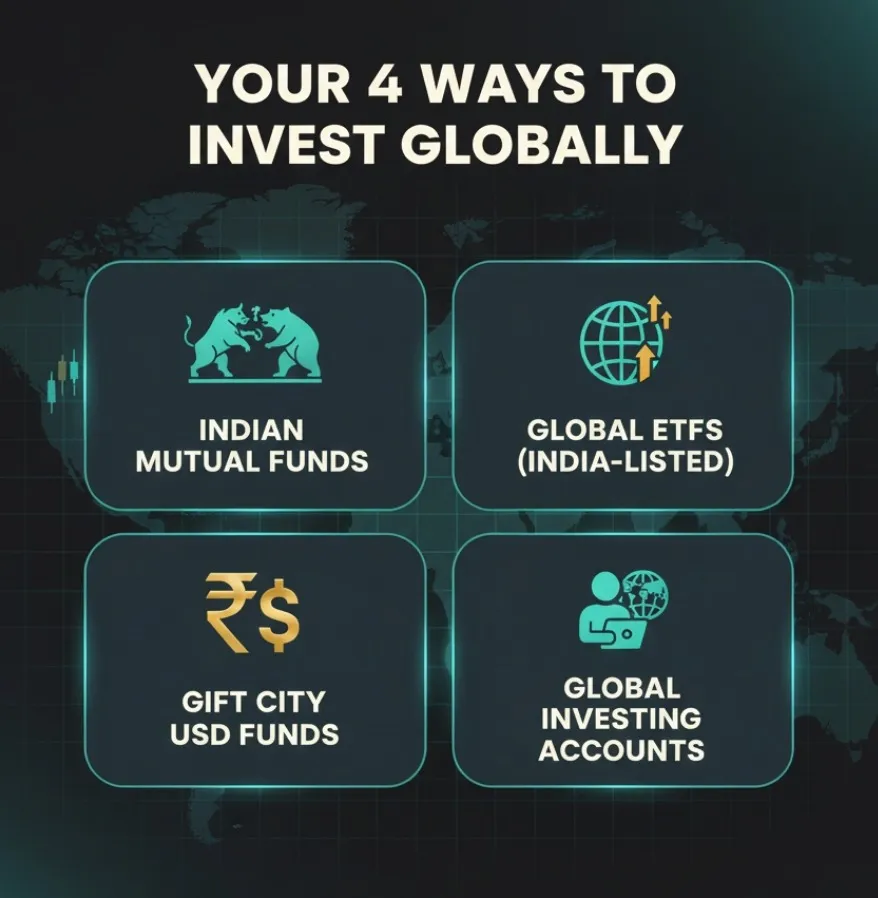
3. Four Practical Routes for Global Investing
Pick the route that best matches your tax comfort, liquidity needs, and desired level of control.
A. Indian mutual funds / Fund-of-funds (FoFs) – the default choice for most
Indian FoFs offer global exposure while keeping taxation and paperwork simple.
Examples include feeder funds into US or China equity mandates.
Tradeoffs include capacity limits and higher expense ratios than direct global ETFs. When feeder limits tighten, consider the GIFT City route.
B. India-listed global ETFs
Examples include NASDAQ 100 ETFs listed domestically. Liquidity varies, so investors should review:
- tracking error
- bid-ask spreads
- AUM stability
ETFs are simple to use but offer fewer choices than offshore platforms.

C. GIFT city funds
These funds allow direct global equity exposure within the Indian regulatory perimeter.
The DSP Global Equity Fund (GIFT City) is a commonly referenced option.
This path helps bypass SEBI’s overseas limits affecting feeder funds.
Tradeoffs: platform access and distribution are still developing.
At truwealth.club, we are actively trying to expand these options for retail investors.
D. Direct US or offshore broking accounts
This gives investors full control and the widest product range.
However, consider:
- FX spreads
- brokerage fees
- US withholding tax
- estate tax obligations
This route is best suited to experienced investors who are comfortable handling global tax rules and operational complexity.
4. What Indians are actually using: AUM and market data
Some of the most visible Indian flows include:
- Edelweiss US Technology Equity FoF – AUM ~INR 3,000 Cr
- Kotak US Specific Equity Passive FoF – AUM ~INR 3,880 Cr
- Axis Greater China Equity FoF – AUM ~INR 1,500 Cr
Global ETF AUM is projected to reach USD 18 trillion by 2026, driven by strong investor demand.
India’s LRS flows for buying overseas stocks and bonds rose more than 50 percent to USD 1.68 billion in 2025, highlighting rising retail and HNI interest.
For individual investors, the INR 10 lakh annual LRS cap remains a key constraint.

5. Your final checklist for Global Investing
Measure
Identify the percentage of your total equity exposure that is global. Convert using the current FX rate, especially now with USD/INR around 90.
Set a band
A typical diversified investor targets 20–30 percent global equity exposure.
Move toward 50 percent only if you fully understand FX risk and global taxation.
Choose your route
- FoFs for the core
- India-listed ETFs for tactical allocation
- GIFT City funds for higher-ticket global exposure
- Direct US broking only after weighing tax and estate considerations
Implement gradually
SIPs into global FoFs and consistent ETF buying help smooth volatility and FX swings.
Review annually
Rebalance if your global allocation drifts significantly. Track:
- regional valuations
- Currency trends
- Interest rate expectations
As you can see, Global Investing is no longer optional for investors who want to stay aligned with where real growth, innovation, and capital flows are heading. The world’s opportunity set is expanding, and the investors who learn to navigate currency, markets, and global product routes with clarity will be the ones compounding ahead of the curve.
If today’s breakdown on Global Investing made things clearer, our last deep dive on investor behaviour adds another layer. It explains why we often wait even when the data tells us not to. Click here to read Investor Mindset reveals why we wait even when we know better.
And since this entire Global Investing framework was first shared with our newsletter subscribers days before it came to the blog, you can get early access too. If you’d like these insights delivered directly to your inbox, click here to subscribe.
1 comment on “Global Investing and the trends that matter now”